Project Walls in Preschool: Making Learning Visible
"Discover how preschool project walls reveal children's questions, experiments and progress, with practical prompts for meaningful parent conversations."
Skip to article
Back to Blogs/Inside preschool
Save Share
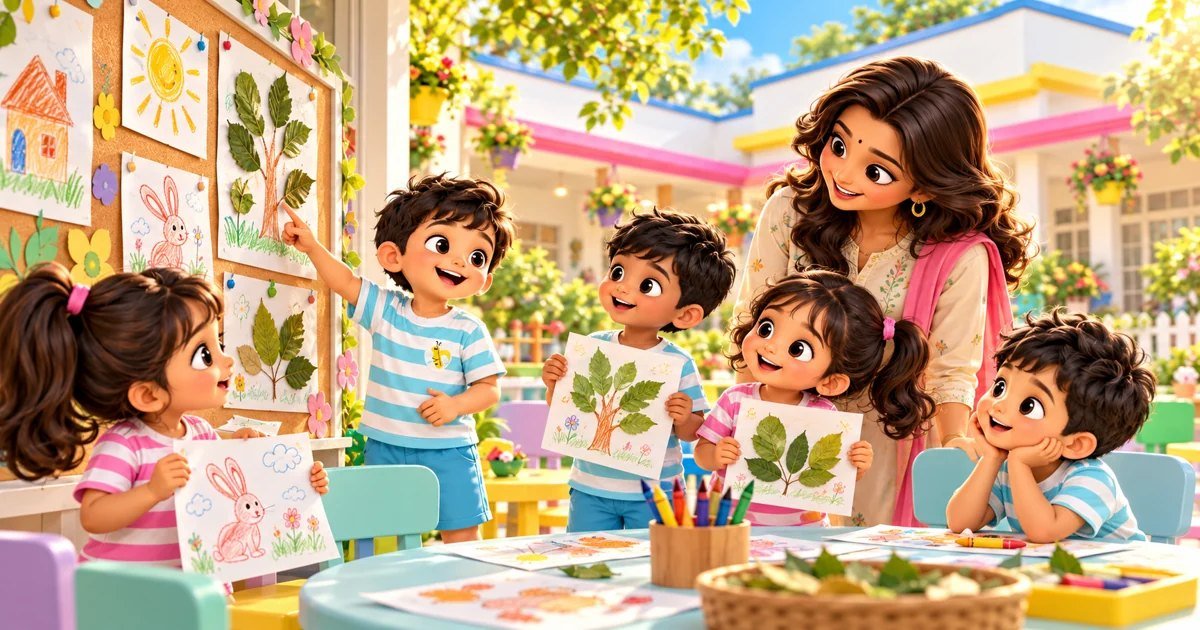
Illustration inspired by Kinderbee’s school setting and uniforms.
Executive Summary & Takeaways
A preschool project wall is a changing display of children's learning. It can bring together drawings, photographs, children's words and teacher observations to show how an idea developed. For families, it offers a useful starting point for conversations about what children are exploring.
A beautiful display may catch your eye during a school visit. The more useful question is: can you understand the children's thinking? A wall of identical flowers tells a different story from sketches, questions and experiments about why some plants grow towards a window.
What belongs on a project wall?
A question that started the investigation
A project might begin with “Where does rain go?” or “Why does our tower keep falling?” Recording the starting question helps families understand the purpose of the work. It also reminds children that their questions matter.
Evidence of the process
Early drawings, a changed design and a short observation can show development over time. A teacher might note that children tried a wider base after a bridge collapsed. The unfinished attempt can be as informative as the final construction.
Children's own explanations
A caption such as “We made this side stronger” gives children a voice. Adults can write down the child's words accurately, including explanations expressed through gestures or a home language. Children should have opportunities to revisit the display and add or revise their ideas.
How does documentation support learning?
Recording an experience is the beginning. The next step is looking at it together: what did we notice, what surprised us, and what could we try next? A display becomes pedagogical documentation when those observations help shape future learning.
Finland's early childhood guidance places observation and pedagogical documentation within ongoing planning and assessment. A project wall is one possible way to put that reflective approach into practice; it is not a requirement to produce elaborate displays.
Three questions parents can ask
Some children will talk at length. Others may point, demonstrate or return to the subject later. A quiet response does not mean that the learning was unimportant.
Keep the display useful and respectful
Choose a manageable amount of work and arrange it where children can see it. Add dates so the sequence is understandable. Include different forms of participation, rather than repeatedly featuring the most talkative children.
For photos and personal information, follow the school's consent and privacy arrangements. A classroom display and a public website have different audiences. Avoid showing children's distress, private developmental notes or identifying details simply to make a learning story more compelling.
TRY IT TOGETHER
A small learning story at home
Keep an early drawing or photograph of a construction. Later, ask your child what changed. Write down one sentence in their words and place it beside the newer version. Two pieces of work can tell a rich story.
Parents often ask
Is a project wall the same as an art display?
There can be overlap. A project wall adds context: the question, decisions, attempts and reflections behind the work. It need not include a polished final product.
Does every activity need photographs?
No. A brief note, a child's drawing or a recorded question may be enough. Documentation should leave adults time to participate and respond.
A useful project wall makes a conversation possible. The goal is to help children and adults notice learning together.
Sources and further reading
See the thinking behind the work
During a Kinderbee visit, ask the team to show you how children's ideas and progress are shared with families.
Talk to the KIPS Franchise Advisory Team →
Kinderbee Research Desk
Practical perspectives on preschool learning, parent partnerships and joyful childhoods from Kinderbee Schools and the KIPS Editorial Team.
Kinderbee Learning Journal
More ideas for joyful early learning
Explore our parenting guides, preschool insights and learning activities.
School–Home Partnership
Let’s support your child’s next steps
Connect with the Kinderbee team to explore our preschool programmes and how children’s learning is shared with families.
Related Publications in Franchise & Business Growth
Engaging Parents Taking Parents Along in Their Child's Learning Journey at the Preschool!
The Zero-Royalty Edge: What It Changes for a Preschool Entrepreneur