Guided Play in Preschool: Helping Curiosity Grow into Learning
"Discover how guided play in preschool connects joyful exploration with clear learning intentions, teacher observations and meaningful parent updates at Kinderbee."
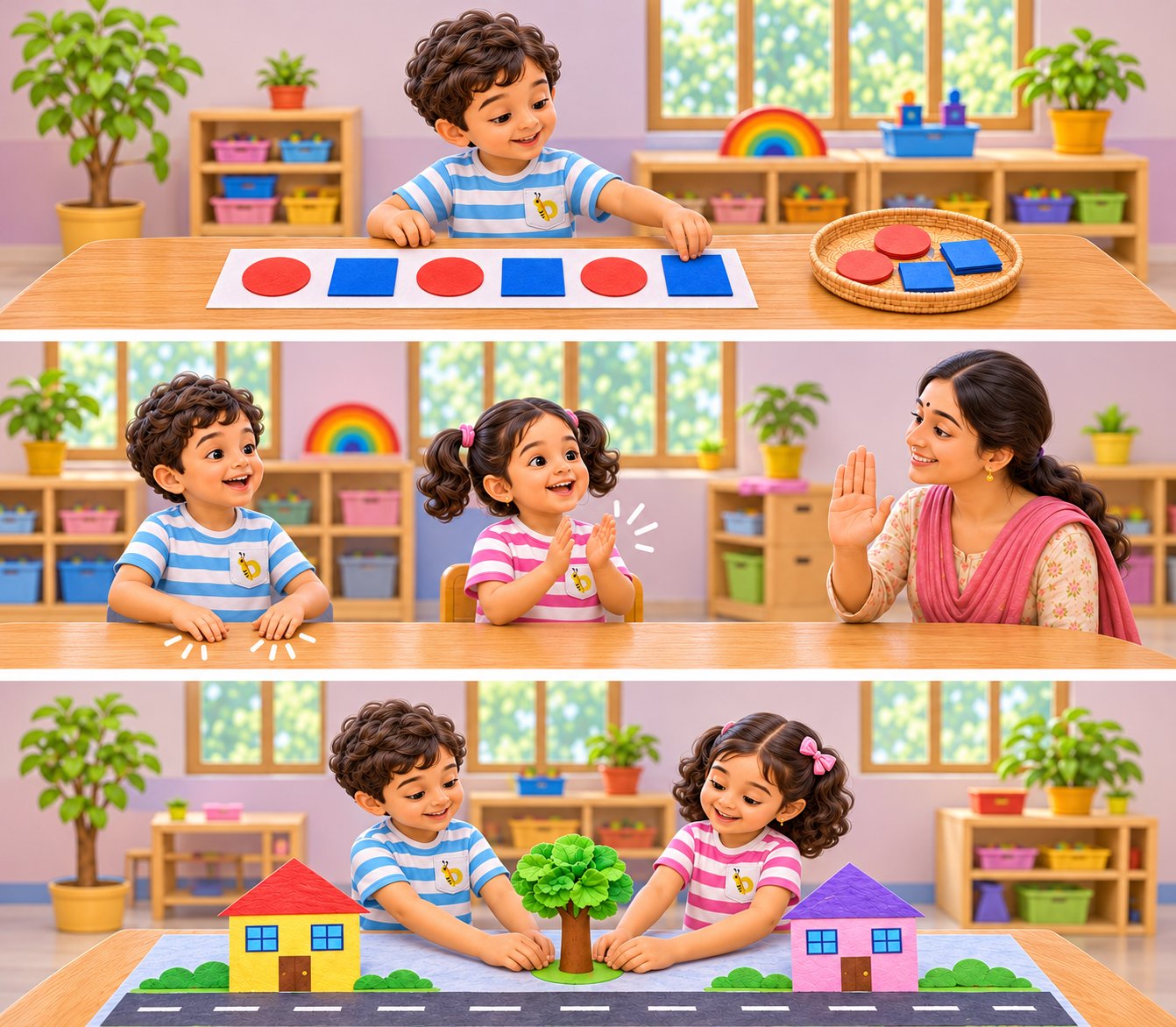
Kinderbee illustrations: patterns, shared rhythms and community play offer different invitations to explore and learn.
What makes play purposeful?
Purposeful play starts with an intention that matters for the children in front of the teacher. It might be noticing a repeating pattern, using words to make a request, comparing lengths or finding a way to work with a friend.
The intention helps the teacher choose materials and decide what to observe. It should leave room for children’s ideas. A teacher planning to explore balance might offer blocks and boards; the children can decide whether they are making a bridge, a garage or a place for a toy animal.
Three ingredients of guided play
A prompt might be “What could you try next?” A demonstration might show how to steady a block while leaving the child to continue building. Guidance can also mean stepping back when a child is absorbed in a useful investigation.
Free play remains valuable. Children need time to invent their own activities, develop interests and enjoy playing together. Guided experiences can sit alongside that time. The goal is a thoughtful balance across the day.
What the research helps us understand
A 2022 systematic review by Skene and colleagues found advantages for guided play over particular comparison approaches on some outcomes, including early mathematics and shape knowledge. It did not establish an advantage for every outcome, and the studies used varied approaches. The practical message is to use guidance thoughtfully and observe the learning that actually occurs. Read the guided play research review.
Families can explore Kinderbee’s preschool programmes and ask how teachers balance exploration, planned invitations and everyday routines.
A classroom example: Discover the next part of a pattern
Illustrative group: Nursery children, adapted to their current experience. Learning intention: notice and continue a simple repeating pattern. Materials: large red circles, large blue squares, a mat and a basket. Choose age-appropriate materials and supervise their use.
The teacher places a red circle, a blue square, a red circle and a blue square on the mat. The rest of the pieces stay within reach. Children are invited to investigate the arrangement and choose what they would like to add.
Let the child think before offering the answer
The teacher might say, “Tell me about what you see,” or “What could come next?” If a child places another red circle, the teacher can invite them to point along the sequence or explain their choice. A child can respond with words, gestures or movement.
If the task is difficult, the teacher can shorten the sequence, model the repeating rhythm or offer two pieces to choose from. If the child is ready for a new challenge, they could make a repeating pattern with different objects or invent a clap-and-tap version.
A different arrangement can become a conversation too. Ask the child what they are making. They may be sorting all the circles together or building a new design. Understanding that intention helps the teacher decide whether to join the new idea or return to the pattern invitation later.
A short plan that teachers can use
Participation can be brief, and children may return to the materials later. One session gives a teacher evidence to consider; it does not require every child to demonstrate the same outcome before moving on.
Choose learning intentions across the preschool years
The same theme can open different possibilities for different groups. Begin with what the children already do, then plan a manageable next step. The examples below are starting points to adapt, rather than fixed age tests.
Familiar people and places can inspire language, matching, role play and route-making. Illustrations show possible learning contexts.
Make learning visible through a useful observation
A useful learning note connects an action to a possible next step. Start with what the child actually did or said. Then add a careful interpretation, keeping the observation separate from what you think it might mean.
For the pattern invitation, a teacher’s note could look like this. The following is an illustrative example, not a record of an actual Kinderbee child.
What happened: Mira added a red circle after the blue square. She pointed along the row and said, “Red, blue, red, blue.”What it may show: She is beginning to notice and continue this repeating arrangement.What comes next: Offer a clap-and-tap pattern and see whether she notices the repeating rhythm with support.
A teacher can use a few sentences, a brief recorded phrase or a permitted photograph with a note. Choose a recording method that fits the school’s approved system and keeps attention on the children. Share identifiable records only through the appropriate school channels and permissions.
Observe progress over time
Revisit the idea in another situation. A child who continues a pattern once may need more time to use it independently or recognise it with unfamiliar objects. Comparing observations across days can reveal what support helps and what the next invitation should be.
Teachers can record unexpected learning too: a new way to ask for help, an explanation offered to a friend or a solution to a practical problem. A planned intention gives focus while leaving space to notice more.
Help parents understand what their child is learning
Parent communication works well when it describes a small, recognisable moment. Explain the activity, the child’s action and the learning you are following. Keep the language clear enough for a family to continue the conversation at home.
A parent-friendly version of the illustrative observation might read:
“Today Mira noticed the red-and-blue pattern and chose the next piece. She described the colours as she pointed along the row. We’ll offer a repeating sound game next to help her explore the same idea in a new way.”
A simple home invitation could be: “Try clap, tap, clap, tap together and let your child decide what to do next.” There is no need to buy a kit or turn the evening into a test. Follow the child’s interest and enjoy the exchange.
At a parent meeting, bring observations from different occasions and ask families what they notice at home. That conversation can help both adults understand the child’s experience more fully.
Show prospective families the thinking behind the play
An admissions visit offers a chance to explain what a teacher notices during a familiar classroom experience. Have a teacher show the materials, describe the learning intention and give an anonymised or illustrative example of how a child’s idea could guide the next step.
For the bridge invitation, the teacher could explain: “We offer blocks and a board so children can test a way to cross a gap. I watch what they try and ask a question when it will help them investigate further. Their changes help me plan the next challenge.”
Use only permitted examples and be clear about which are illustrative. Families can ask how teachers plan, observe and adapt learning across the week. Arrange a Kinderbee school visit or speak with our team to discuss the approach.
Build a weekly routine for purposeful play
A shared routine can make planning and coaching more concrete. Begin with one learning intention that is relevant to the group, then use the week to explore, observe and adjust it.
The academic coordinator can ask, “Which prompt opened up the child’s thinking?” and “Where did the activity need more choice or support?” These questions help a team reflect on practice without requiring a long report for every moment of play.
Download the KIPS guided play planner
The planner provides blank spaces for the learning intention, invitation, child’s action, interpretation, next step and parent-friendly update. Use it within your school’s approved arrangements for storing children’s information.
Support teachers with planning resources and practical coaching
Useful support includes opportunities to practise selecting a learning intention, arranging materials, asking open questions and interpreting observations. A lesson plan becomes more useful when teachers can adapt it confidently.
Kinderbee’s FinnishWay Academy teacher-development programmes describe play-based teaching, activity planning and practical preparation. Ask the team about the current programme and the support relevant to your teaching role.
Where AI-assisted planning is used, it can help prepare a draft activity or observation template from approved resources. The teacher checks suitability, prepares the materials and makes classroom decisions. Children’s learning notes must reflect what was actually observed.
For prospective partners, explore the Kinderbee preschool franchise and ask to see how curriculum resources, teacher preparation and ongoing support fit together. Agree the included scope in writing.
Frequently asked questions about guided play in preschool
How is guided play different from free play?
Guided play combines an adult’s learning intention with children’s choices and responsive support. In free play, children have greater control over the direction and goals of the activity. Both can contribute to a balanced preschool day.
Does purposeful play mean every activity needs a correct answer?
No. A learning intention can focus on exploring, explaining, trying a strategy or taking part with others. Children may find different solutions, reveal unexpected interests or need another opportunity to develop an idea.
How can teachers tell whether a child learned something?
Record specific actions, words or gestures, then revisit the idea over time. Notice what the child does independently, what support is helpful and whether the idea appears in a new situation. Use those observations to plan.
Can parents use guided play at home?
Yes. Start with an interest, offer safe materials and try a gentle prompt. Wait for the child’s response and follow their ideas. The exchange can stay short, enjoyable and informal.
Are worksheets required to show learning?
No. Conversations, constructions, pretend play, movement and teacher observations can provide useful evidence. Choose documentation that suits the experience and the child rather than adding a worksheet to every activity.
Begin with a learning intention you can notice
Choose one playful invitation for your next planning conversation. Decide what children will be free to explore, what the teacher will listen for and how an observation could shape the next experience.
Families are welcome to ask about learning at Kinderbee. Educators can explore practical teacher development, and school owners can discuss a KIPS preschool partnership.
Warm regards, Team KIPS Kinderbee International Preschool
Related Publications in Early Pedagogy & Parent Trust

AI-Ready Preschool Franchise in India: How KIPS Supports Admissions, Teaching and Daily Operations

Why partner with Kinderbee? An AI-ready preschool from first enquiry to classroom