NEP 2020 and the Foundational Stage: What a Preschool Operator Should Understand
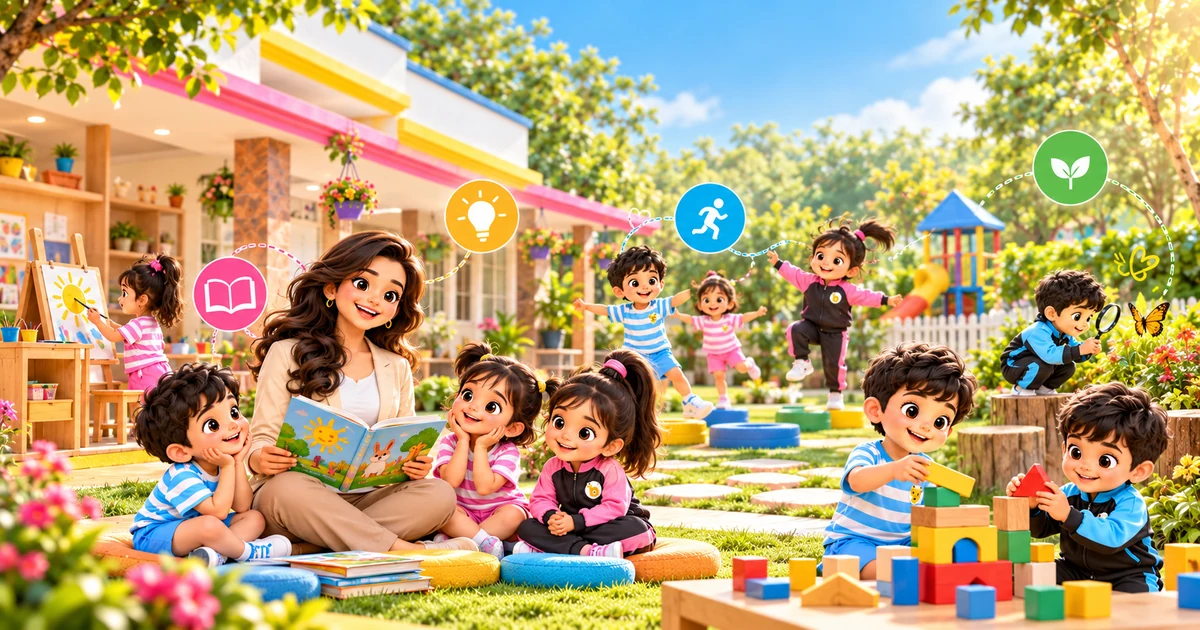
"Why play, language, movement, relationships and developmentally appropriate experiences matter more than turning preschool into an early primary classroom."
For preschool operators, NEP 2020 is not simply a label to place on a brochure. The Foundational Stage vision is connected to how young children actually learn: through play, activity, interaction, language, movement, exploration and nurturing relationships. A franchise system should help teachers make those principles visible in daily practice.
The Foundational Stage changes the conversation
India’s National Curriculum Framework for the Foundational Stage describes children as active, curious learners and places play at the core of curriculum and pedagogy. It recognises free play, guided play and structured play as part of a balanced early-years experience.
For an operator, this means quality should not be judged by the number of worksheets completed. The more useful questions are: Are children talking, moving, exploring, imagining, listening, creating and gradually developing foundational language and mathematical thinking?
Alignment should be visible in the timetable
A programme that claims alignment should be able to show where children experience stories, conversations, rhymes, art, music, physical movement, early mathematical thinking, nature, role play and opportunities to choose and explore.
The timetable should also allow routines, rest, care and transitions to be developmentally appropriate. Preschool is not a compressed version of Grade 1.
Teacher behaviour matters as much as the lesson plan
Guided play requires adults who can observe, ask good questions and extend thinking without controlling every answer. That is why teacher preparation is central to any serious early-years model.
A KIPS partner should therefore evaluate not only the curriculum files but also how teachers are trained to facilitate them and document children’s learning.
Local language and culture belong in the classroom
An all-India preschool network must balance consistency with local relevance. Children understand new ideas through familiar language, people, objects, songs, stories and community experiences. A framework can be common while classroom examples remain rooted in the child’s world.
That balance is especially important when a brand describes its approach as Nordic-inspired: inspiration should strengthen child-centred practice, not erase Indian languages or contexts.
Operator audit: Pick one ordinary day and ask: How much time is spent listening to the teacher, and how much time are children actively talking, moving, making, choosing, exploring or solving? The answer tells you more than a compliance slogan.
Questions readers often ask
Does NEP 2020 ban worksheets in preschool?
No. The issue is balance and developmental appropriateness. Young children need rich play, interaction and hands-on experience; paper tasks should not dominate the day.
Is ‘NEP-aligned’ a government certification?
Not by itself. A preschool should explain how its curriculum and pedagogy reflect the principles of the national framework rather than imply a certification that has not been granted.
Ask to see the pedagogy in practice
When evaluating Kinderbee through KIPS, request sample programme plans and ask how teacher training translates play-based foundational learning into an ordinary classroom day.
Explore the Kinderbee Learning Model →
Sources and further reading
Related Publications in Franchise & Business Growth
The Zero-Royalty Edge: What It Changes for a Preschool Entrepreneur
A Financial Blueprint for Starting a Premium Preschool in India