Ready for Grade 1: What a Strong Sr KG Programme Should Really Build
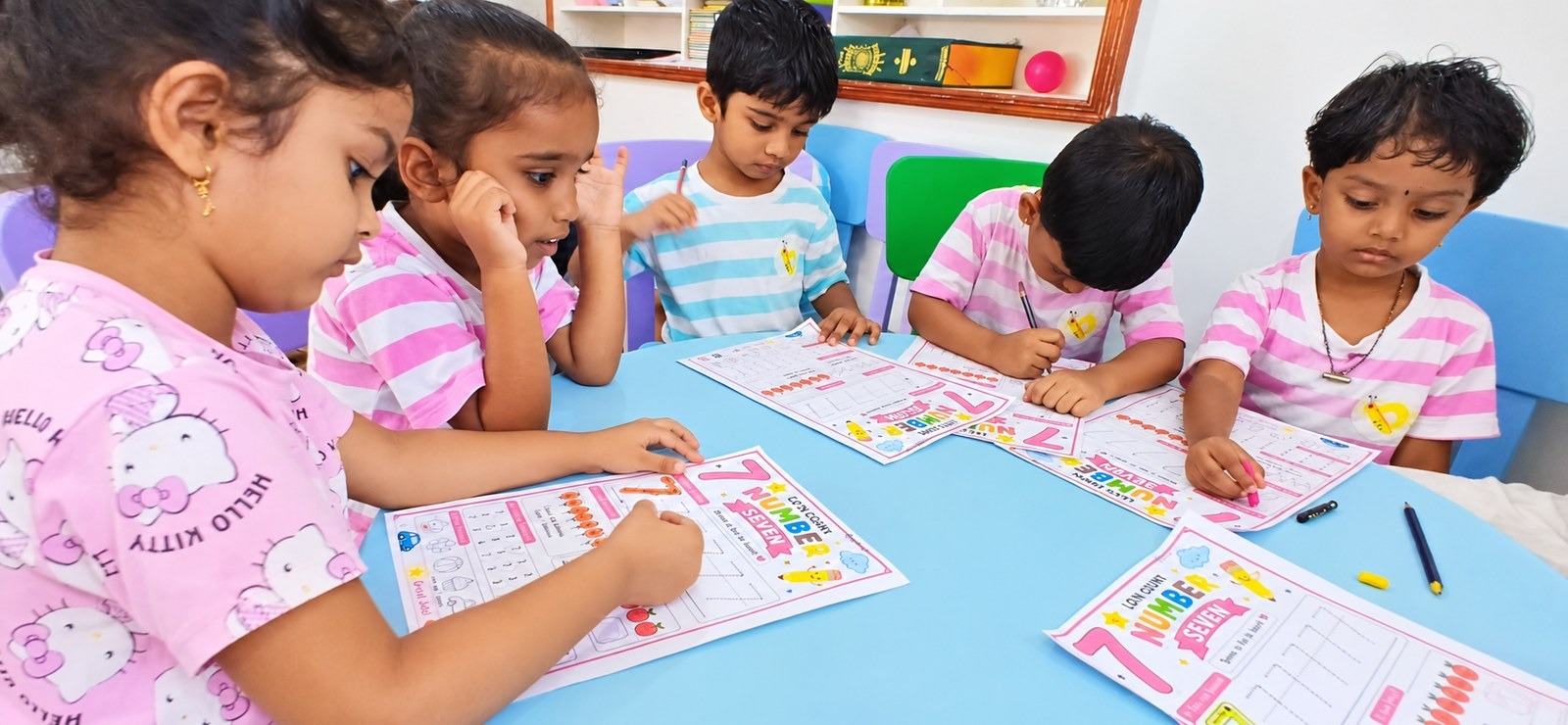
"School readiness is broader than reading a list of words or filling worksheets quickly; it includes language, number sense, independence, attention, confidence and curiosity."
As Sr KG ends, families naturally think about Grade 1. The strongest preparation is not to turn kindergarten into primary school early. It is to help children enter Grade 1 with secure foundations: they can communicate, listen, participate, think with numbers, engage with print, manage routines and approach new learning with confidence.
Language comes before performance
Children need to understand instructions, ask for help, talk about experiences, listen to stories and express ideas. Early reading and writing grow more strongly when oral language and comprehension develop alongside phonics and print knowledge.
A child who can decode a word but cannot explain a simple story still needs rich language experiences.
Number sense is more than writing numerals
Grade 1 mathematics is easier when children understand quantity, comparison, patterns, shapes and simple relationships between numbers. Counting real objects, making groups, comparing ‘more’ and ‘less’, and solving everyday problems build meaning behind written numerals.
Hands-on mathematical thinking should continue even when children begin formal written work.
Independence makes the school day easier
Being able to manage belongings, use the toilet, eat with growing independence, follow simple routines and transition between activities helps a child use more attention for learning.
Families can support these skills by allowing children to do manageable tasks themselves rather than stepping in immediately.
Attention is not the same as sitting still
Young children can concentrate deeply when they are interested. A strong kindergarten builds the ability to listen, participate in a group, complete a short task, persist with a puzzle and return attention after movement or a transition.
Expecting long periods of passive sitting is not the only way to prepare for school.
Confidence grows through appropriate challenge
Children need chances to try, make mistakes, ask questions and improve. When adults correct every small error immediately, children can become dependent on approval. Thoughtful teachers use prompts and feedback that help children think again.
That disposition—‘I can try another way’—is one of the most useful things a child can carry into Grade 1.
Grade 1 readiness check-in: Ask five broad questions: Can my child communicate needs? Join a group routine? Engage with stories and print? Think with small quantities? Attempt a task without giving up immediately? Use these as conversation starters, not a pass/fail test.
Questions readers often ask
Does my child need to read fluently before Grade 1?
Requirements differ across schools, but readiness is broader than fluency. Strong language, phonological awareness, print understanding and confidence with books provide an important foundation.
Should we use extra worksheets during the holidays before Grade 1?
A small amount of familiar practice can be fine, but reading together, conversation, drawing, games, outdoor play and everyday maths can maintain learning without turning the break into tuition.
Build foundations that travel with the child
Ask your Kinderbee centre how Sr KG integrates early literacy, mathematics, communication, independence and confidence as children prepare for the next stage of school.
Explore the Sr KG Learning Journey →
Sources and further reading
Related Publications in Early Pedagogy & Parent Trust
The Zero-Royalty Edge: What It Changes for a Preschool Entrepreneur
A Financial Blueprint for Starting a Premium Preschool in India